
In certain parts of the world, people are thought to live longer thanks to their diet, exercise habits and close social connections. Recently, however, doubts have been raised about this theory. Do these regions – known as “blue zones” – really produce an extraordinary number of centenarians, or is this just a myth based on inaccurate data and clever marketing?
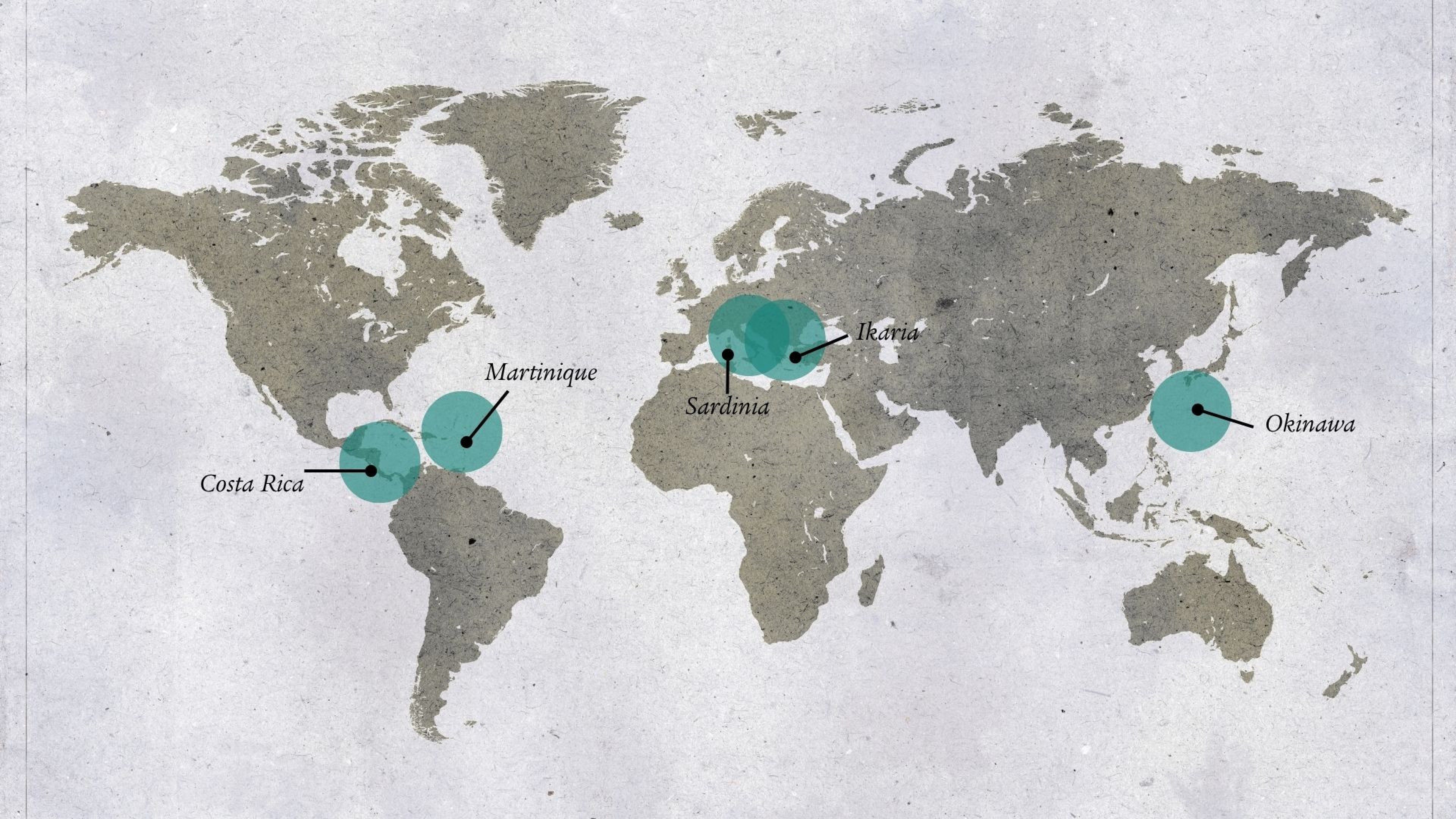
Are there regions of the world where people are particularly likely to live to 100? This question has fascinated researchers and the public alike for more than 20 years. The story has its origins in Sardinia. Around the turn of the millennium, when demographer Michel Poulain and doctor Gianni Pes first studied villages on the Mediterranean island with an above-average number of centenarians, they circled them on their map with a blue pencil. US journalist Dan Buettner later picked up on these markings and the regions became known worldwide as “blue zones”. In addition to parts of the Italian island of Sardinia, Buettner’s original five blue zones include Nicoya in Costa Rica, the Greek island of Ikaria and the Japanese archipelago of Okinawa. Whether the small town of Loma Linda in California also belongs to this group is under dispute. Michel Poulain subsequently identified Martinique as a new blue zone.
The “Power 9”
At first glance, the five blue zones described by Buettner seem to have little in common, scattered as they are across different continents. However, closer scientific research has shown that people in these regions share nine basic behaviours that could contribute to their above-average life expectancy and health. Buettner coined the term “Power 9” to summarise these habits. They include getting a lot of daily exercise, conscious relaxation, very low meat consumption, and a sense of belonging to society through strong social networks and lifelong friendships.

Special lifestyle or incorrect data
In recent years, however, scientists have become increasingly critical of the blue zones concept. At the heart of the debate is the question of whether the exceptionally high number of centenarians in these regions is genuinely due to a particular lifestyle, or whether incorrect age data play a greater role than previously assumed. Demographer Saul Justin Newman, for example, argues that some regions with strikingly large numbers of very old people also have a history of incomplete birth registers and other documentation problems. Some of the reported age records could therefore be attributable to errors, false reports or mix-ups.
Other critics point to another contradiction: some blue zones are characterised by poverty, low education levels or comparatively weak healthcare systems. It is therefore difficult to imagine that the observed longevity can be explained solely by healthy lifestyles. Moreover, most of the findings on nutrition, exercise and social relationships are based on observational studies. Such studies show correlations, but only provide limited proof as to which factors are actually responsible for longevity. However, these criticisms do not mean that the basic idea of the blue zones has been discredited. Many of the behaviours described are regarded as health-promoting anyway. That said, it remains debatable whether they can actually explain the high number of centenarians and how reliable the underlying age data are. From the critics’ point of view, therefore, the blue zones are not so much proof as an interesting hypothesis about the causes of longevity.
Hype for profit?
The ongoing interest in the blue zones has also led to the emergence of a profitable ecosystem. A key part of this ecosystem is the journalist Dan Buettner himself, who has made the concept famous worldwide through books, lectures, documentaries and media partnerships. The more attractive and convincing the narrative appears, the greater the interest in lectures, consulting services and media projects.
The idea that a long life is attainable through simple behaviours gives people a sense of hope and direction. More complex scientific explanations – such as the interplay of genetics, chance, social factors and medical care – are less easy for the general public to grasp.
Media companies and streaming platforms also benefit from the blue zones concept. Stories about remote islands, fighting-fit centenarians and the secrets of a long life are easier to tell and market than statistical debates about data quality or demographic methods.
What stands up to the criticism?
The real question is this: how reliable are the age data and what role do nutrition, exercise, social ties, genetics and other factors actually play in longevity?
Professor Daniela Jopp from the University of Lausanne is lead project manager for the SWISS 100 study, the first national study of centenarians in Switzerland. She has strong words to say about the ongoing criticism of the blue zones: “People in the blue zones are accused of keeping their deceased family members in their freezers in order to collect their pensions. This suggestion is simply outrageous. In Sardinia, for example, every municipality has very accurate records of all births and deaths, and church records also provide insightful data. In addition, centenarians in both Costa Rica and Japan receive annual visits from community or government officials.”

She and her research group have interviewed many centenarians in Switzerland. As a result, Jopp knows which blue zone criteria are relevant for centenarians in Switzerland: “A large number of centenarians in Switzerland have regular contact with many family members. From many studies with people of all ages, we know that social inclusion is crucial for wellbeing, and that the health consequences of loneliness are comparable to smoking a pack of cigarettes a day. What you also see in the blue zones is that old and very old people are respected and continue to play an important role in society – other countries could learn from that.” In addition, her research group observed that other key factors, such as a healthy diet, remaining active and exercise – aspects that are part of a beneficial lifestyle everywhere, not only in the blue zones – are also relevant among Swiss centenarians.
New findings
Alongside the behaviours defined as conducive to a long life in previous studies, the Swiss research group has also identified a new factor: “Biologically, the centenarians included in our study have a protein profile that is similar to that of much younger people. Particularly striking are proteins that are linked to metabolism and inflammation and, for example, protect the body from oxidative stress.” Daniela Jopp was also surprised by another finding: “Swiss centenarians are satisfied with their lives. I knew from previous studies that many very old people have high levels of wellbeing, but in Switzerland, 92% said they were satisfied with their lives. That’s a remarkable figure!”
What we can learn from centenarians: Findings from a nationwide study
SWISS100 ist die erste landesweite Studie über Hundertjährige in der Schweiz. Sie wurde von Expertinnen und Experten unterschiedlicher Disziplinen durchgeführt. Das Projekt begann im Jahr 2020; die aktive Datenerhebung endete 2025. Unter der Leitung von Prof. Dr. Daniela Jopp fanden Forschende aus Soziologie, Psychologie und Medizin verschiedene Faktoren, die ein besonders langes Leben ermöglichen, und untersuchten die Lebensqualität im hohen Alter.